Chernobyl: 40 Years of Learning
Sat, 16 May, 2026
Read in 8 minutes
VIDEO TRANSCRIPT - What actually happened at Chernobyl?
You can view the video here: Chernobyl: 40 Years of Learning
About This Transcript
This transcript is taken from the original video script and may differ in phrasing from the video discussion. For phrasing accurate transcription, please use the video subtitles.
Although care has been taken in the writing of this article, it is possible that factual errors may still be present. Please contact me if you spot any issues.
On Saturday the 26th of April 1986, at 1:24 AM Moscow Summer Time, most people in Ukraine were fast asleep - oblivious to the explosion which had just started the world’s largest nuclear disaster.
I am of course talking about the Chernobyl disaster, the now 40-year-old accident which has redefined nuclear safety. So, what actually happened?
Testing
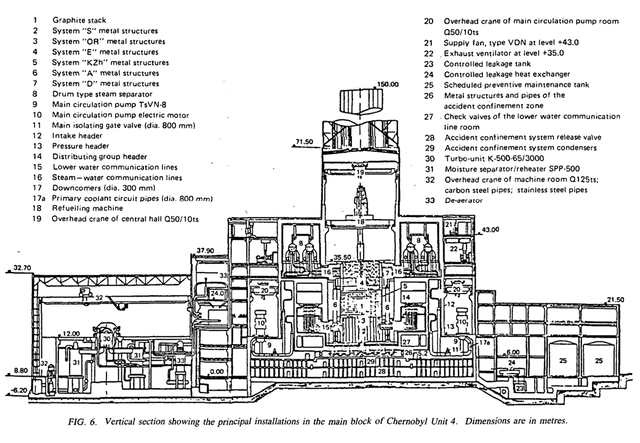
The operators of the Chernobyl nuclear power plant were preparing to test the emergency power systems of Unit 4 - one of the four reactors of the plant. They wanted to determine whether the output of one of the reactor’s steam turbines could power the feedwater pumps, responsible for supplying cooling water, before backup diesel generators started.
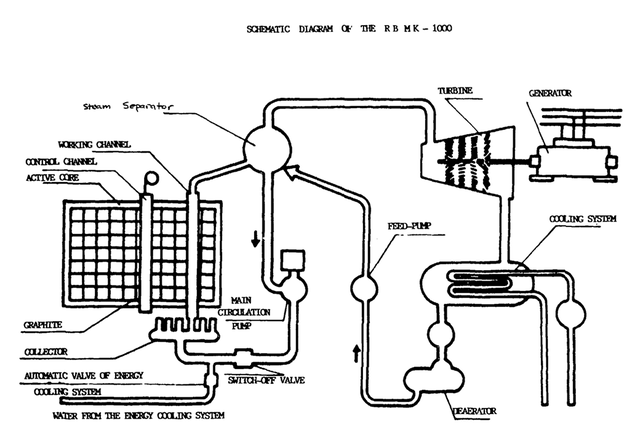
During the preparation, the reactor output needed to be reduced to 22 to 32% of the total power, and the operators began to reduce the power level at 1 PM on the 25th of April. However, this is where the problems begin. The computer system controlling the reactor was incorrectly programmed and did not maintain reactor power at the required 30%, instead it reduced down to just 1%.
Now, in contradiction to what you might think, this was actually a very bad thing. When reactor temperature decreases, the water coolant condenses and slows down the neutrons emitted by the nuclear fuel. You might need a bit more context for what that means:
Controlling Neutrons
Inside nuclear reactors, a fuel (in this case uranium) undergoes fission, where one atom splits into two smaller atoms, some neutrons, and of course energy. These neutrons are the important part, as they go on to cause further fissions in a chain reaction. But, the neutrons produced are travelling too fast to be absorbed by other atoms so they have to be slowed down before they cause other fission reactions.
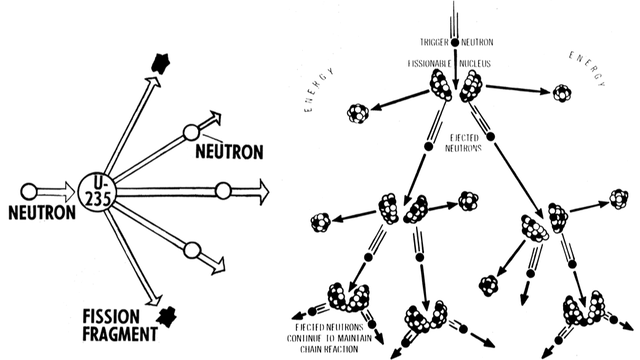
One of the main roles of the operators is to make sure that the chain reaction is controlled by inserting or removing control rods which absorb neutrons and thus change the rate of reaction (called reactivity). Inserting the control rods fully absorbs all of the neutrons in the reactor and stops energy production.
Warning Signs
You might now be able to see the problem, if neutrons are slowed by the liquid water then the reactivity increases and the core becomes more uncontrollable. Luckily, the control rods were still inside the core so nothing happened. That was, until the operators removed control rods to try to increase the power generated. And… Nothing happened. The reactor power increased from 1% to only 7%.
That is still far from the required power level. So, what stopped it? Xenon gas.
You might remember that the fission of uranium produces two other atoms. These in turn decay further and, before you know it, we have a whole host of atoms in the core. One of them is xenon. Normally, this doesn’t cause any problems, as the xenon decays from the intense conditions inside the reactor. However, if the core reactivity is too low, the gas absorbs neutrons and prevents the reactor from starting. Hence, the reactor power didn’t really increase.
The operators decided, once again, to remove control rods. The idea was, by removing more control rods, there was less neutron absorption and the power should increase and the xenon decay away. It did not. Here, human error steps in once more, and it was decided that the 7% power level was enough for the test. At this point, of the 211 reactor control rods only somewhere around 6 to 8 were inserted into the core, and, to make matters worse, most of the safety systems had been disabled to keep the system from performing an emergency shutdown (called a scram).
The Scram
The operators began the test by cutting the steam supply to the turbine, causing the feedwater pumps - now powered by the turbine - to slowly run down. The reduction in coolant flow caused the reactor core to rise in temperature and the water coolant to start boiling, increasing the reactivity of the system. This in turn, heated the water more in an uncontrollable feedback loop. The core was getting hotter and hotter, until the operators realised the situation and pressed the scram button - inserting all the control rods into the reactor. Which would, ordinarily, stop the chain reaction.
But, the Chernobyl reactor had one fatal design flaw which no one had foreseen. The control rods were tipped with graphite, which increased the reactor power when the rods were removed. This meant that when the rods began to be inserted, the graphite tips moved into the centre of the core before the control rod. Now, the thing about graphite is it slows neutrons, which is why it increases the power, but also why it caused the reactor to heat up more whilst the control rods were being inserted.
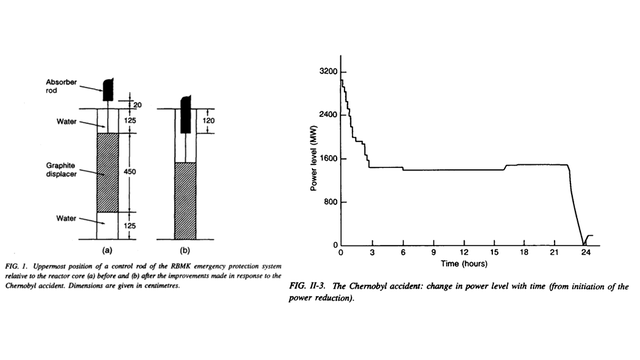
This, combined with the extremely slow 18 second rod insert time, caused the core to rapidly increase in heat and power, reaching 100 times the normal power level in just four seconds, breaking the fuel apart and warping the control rod channels. Then, a massive explosion ripped through the reactor, steam had built up to uncontrollable levels and burst out the top of the reactor vessel - flinging off the top of the shielding straight through the roof of Unit 4.
That was the explosion at 1:24 AM, the result of the worst nuclear meltdown in history.
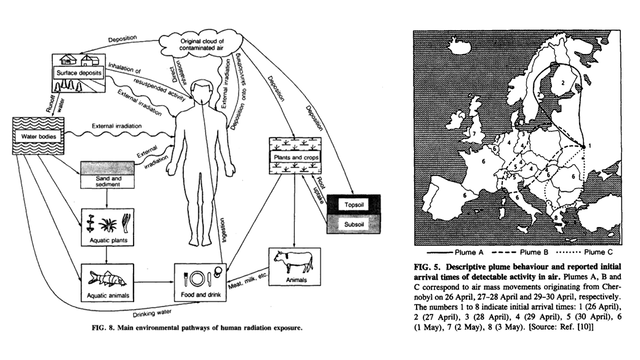
Firemen rushed to the scene to tackle the resulting blaze and the rapidly spreading nuclear material. The situation was finally controlled on the 6th of May, 9 days after the accident, and directly killed thirty people, with many more affected by the airborne radiation spread over 200 000 square kilometres.
A Safety Legacy
Now, that’s obviously not the end of the story. International support and cooperation over the past 40 years enabled the construction of the New Safe Confinement in 2017, an enclosed arch built and moved to cover Unit 4. The confinement structure is so large that two Notre-Dame cathedrals could fit inside.
Chernobyl is still being decommissioned today, and the site is not expected to be clear of radioactive material until 2086, 100 years after the disaster.
So, how can we ensure this never happens again? It starts by remembering the disaster and its consequences - not as a reason against nuclear power, but a reason to aim for better standards of safety and operator training. The International Atomic Energy Agency, the governing body for nuclear power has made many policy changes since the disaster and ensures that all nuclear reactors are built to high standards to prevent future accidents.
The take away message from me is not to oppose nuclear projects. We need more reliable long term energy sources and nuclear power provides a fantastic alternative to fossil fuels. The vast majority of reactors provide power completely unnoticed, without any accidents or disasters, and it’s because of past mistakes that nuclear is now one of the safest forms of energy production - far safer than fossil fuels.
Filming by Dhillon Johal. Thanks to Royal Holloway, University of London, for filming permission.
Sources
- Čirjak, A. (2020). How Far Did Chernobyl Radiation Reach? [online] WorldAtlas. Available at: worldatlas.com/articles/how-far-did-chernobyl-radiation-reach.html [Accessed 16 May 2026].
- Institution of Civil Engineers (2016). Chernobyl new safe confinement. [online] Institution of Civil Engineers (ICE). Available at: ice.org.uk/what-is-civil-engineering/infrastructure-projects/chernobyl-new-safe-confinement [Accessed 16 May 2026].
- International Chernobyl Project International Advisory Committee (1991). Assessment of Radiological Consequences and Evaluation of Protective Measures. [online] Vienna: International Atomic Energy Agency. Available at: www-pub.iaea.org/MTCD/publications/PDF/Pub885e_web.pdf.
- International Nuclear Safety Advisory Group (1986). INSAG-1 Summary Report on the Post-Accident Review Meeting on the Chernobyl Accident. Vienna: International Atomic Energy Agency.
- International Nuclear Safety Advisory Group (1992). INSAG-7 The Chernobyl Accident: Updating of INSAG-1. [online] Vienna: International Atomic Energy Agency. Available at: www-pub.iaea.org/MTCD/publications/PDF/Pub913e_web.pdf.
- Maden, C., Pipe, W. and Hunt, A. (2026). Chernobyl at 40: The decommissioning challenge. [online] World Nuclear News. Available at: world-nuclear-news.org/articles/chernobyl-at-40-the-decommissioning-challenge-and-the-future#group-section-The-future-fouw0otdDO [Accessed 16 May 2026].
- Pinchuk, N. (2019). Chernobyl accident timeline. [online] What is Nuclear. Available at: whatisnuclear.com/chernobyl-timeline.html [Accessed 16 May 2026].
- USSR State Committee on the Utilization of Atomic Energy (1986). The Accident at the Chernobyl’ Nuclear Power Plant and Its Consequences. USSR State Committee on the Utilization of Atomic Energy.
- Wikipedia Contributors (2025). Void coefficient. [online] Wikipedia. Available at: en.wikipedia.org/wiki/Void_coefficient [Accessed 16 May 2026].
- Wikipedia Contributors (2026). Chernobyl disaster. [online] Wikipedia. Available at: en.wikipedia.org/wiki/Chernobyl_disaster [Accessed 16 May 2026].
- Wikipedia Contributors (2026). RBMK. [online] Wikipedia. Available at: en.wikipedia.org/wiki/RBMK [Accessed 16 May 2026].
- World Nuclear Association (2022). Sequence of Events – Chernobyl Accident Appendix 1. [online] World Nuclear Association. Available at: world-nuclear.org/information-library/appendices/chernobyl-accident-appendix-1-sequence-of-events [Accessed 16 May 2026].
- World Nuclear Association (2025). Chernobyl Accident 1986. [online] World Nuclear Association. Available at: world-nuclear.org/information-library/safety-and-security/safety-of-plants/chernobyl-accident [Accessed 16 May 2026].
Read more about how I use Wikipedia.
Image and Video Credit:
- Figure 6 reproduced from INSAG-1 Summary Report on the Post-Accident Review Meeting on the Chernobyl Accident [modified]
- “Schematic Diagram of the RBMK-1000” reproduced from The Accident at the Chernobyl’ Nuclear Power Plant and Its Consequences [modified]
- “Fission” by Pearson Scott Foresman, Public domain, via Wikimedia Commons [modified]
- “HD.6D.752” (Chain Reaction Diagram) by ENERGY.GOV, Public domain, via Wikimedia Commons [modified]
- Figures 1 and II-3 reproduced from INSAG-7 The Chernobyl Accident: Updating of INSAG-1 [modified]
- Figures 8 (Section B) and 5 (Section C) reproduced from Assessment of Radiological Consequences and Evaluation of Protective Measures [modified]