The Nobel Prize in Physics 2025
Fri, 19 Dec, 2025
Read in 3 minutes
VIDEO TRANSCRIPT - What is the largest system that exhibits quantum effects?
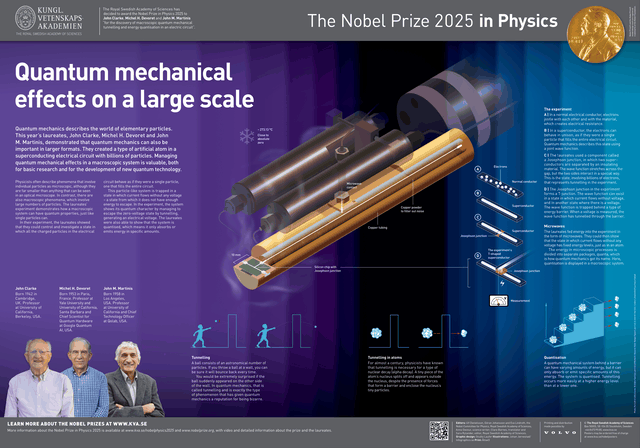
You can view the video here: The Nobel Prize in Physics 2025
The Nobel Prize posters are here, it’s time to talk about the Nobel Prize in Physics!
The Nobel Prize in Physics 2025 was awarded jointly to John Clarke, Michel H. Devoret and John M. Martinis “for the discovery of macroscopic quantum mechanical tunnelling and energy quantisation in an electric circuit” (The Royal Swedish Academy of Sciences, 2025)
That’s a bit of a mouthful - so let’s break it down…
The Quantum Scale
The question of the Nobel Prize this year is: “What is the largest system that exhibits quantum effects?” - how large can we make a system before quantum effects are unobservable?
How did they answer that?
Explaining the Prize
Electrons in Superconductors
Let’s start with a bit of theory. In superconductors, electrons form pairs - known as Cooper pairs - with electrons of opposing spin states. So, we have a spin up electron paired with a spin down electron. Now, electrons are usually subject to the Pauli exclusion principle, which says that no two electrons can occupy the same state.
However, electrons in a Cooper pair act as one single particle and this means that their combined properties result in the pair not being subject to the exclusion principle. Because of this, these particles form a condensate, a system where all of the Cooper pairs are in the same state and that means that all of our Cooper pairs also act as one even bigger particle.
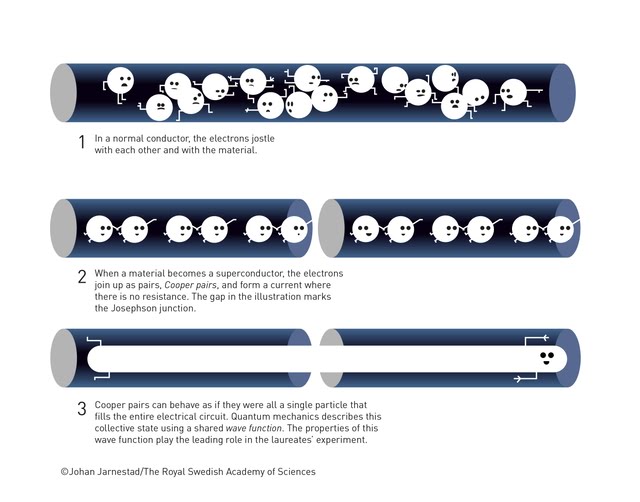
That’s Superconductors for Ya
From 1984 to 1985, our Nobel laureates utilised this fact in something called a Josephson junction - a component formed from two superconducting layers separated by a thin non-conducting layer. This allowed them to observe quantum effects.
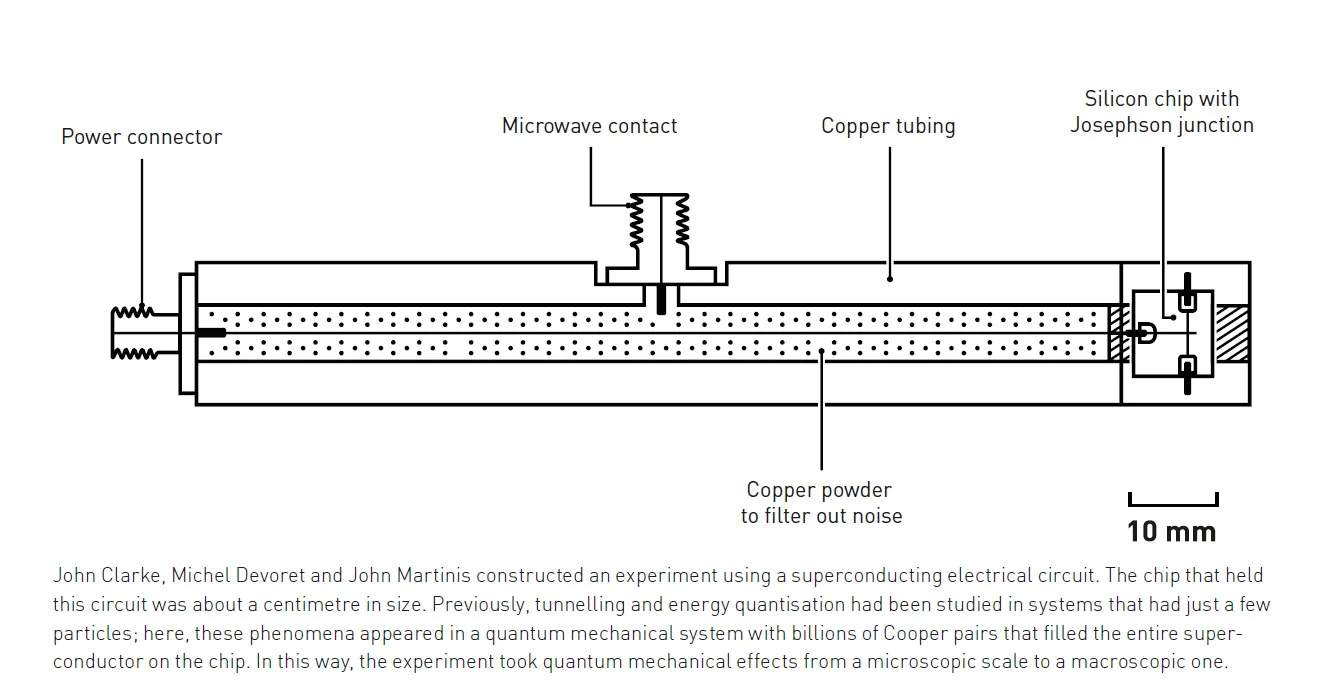
Firing Little Waves at Electrons
What are Quantum Effects
But, what effects are we talking about here? All quantum systems are (1.) quantised, and they (2.) show tunnelling:
A quantised system, first of all, can only emit or absorb certain amounts of energy, the team used microwave radiation of different frequencies to add energy to the system and observed that there was only an increase in energy at specific frequencies. Now, that’s one tick.
But, tunnelling, if you leave a trapped quantum system for a long enough period of time - we’re talking about a random effect here - the system will eventually tunnel out of its trap, this is known as quantum tunnelling and that occurs because we deal not with particles, but with wavefunctions in quantum mechanics.
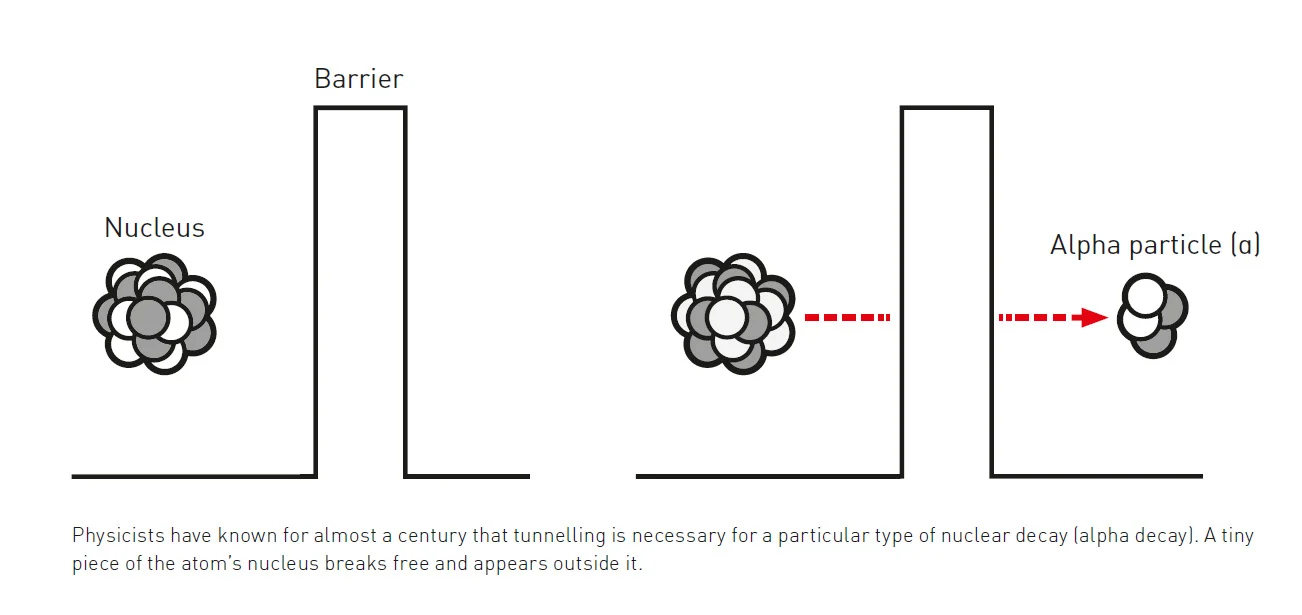
I’m Trapped! Not Anymore…
The laureates observed tunnelling by introducing a current to the Josephson junction: we would expect there to be no voltage flowing across the junction as there is a non-conducting barrier. But, that’s not what they found! Instead, a little while after the current was introduced, a voltage did indeed flow. That’s a voltage across somewhere where there would not normally be a voltage - and that’s because of quantum tunnelling!
Conclusion
All of this demonstrates that quantum effects occur over scales much larger than we initially thought, as we traditionally observe these effects for single particles, but we now have evidence - thanks to our laureates - of quantum effects for a system of billions of particles.
And you might just find that - pretty cool.
You can view and order the Nobel Prize poster on the Royal Swedish Academy of Sciences website.
Sources
- Patel, P. (2020). What Are Cooper Pairs & How Are They Responsible For Superconductivity? [online] Science ABC. Available at: scienceabc.com/pure-sciences/what-are-cooper-pairs-how-are-they-responsible-for-superconductivity.html [Accessed 19 Dec. 2025].
- The Royal Swedish Academy of Sciences (2025). Nobel Prize in Physics 2025. [online] The Nobel Prize. Available at: nobelprize.org/prizes/physics/2025/press-release [Accessed 19 Dec. 2025].
Image Credit:
- Thumbnail from The Royal Swedish Academy of Sciences, 2025
- Other images from Johan Jarnestad/The Royal Swedish Academy of Sciences, 2025