The World's Largest Physics Experiment
VIDEO TRANSCRIPT - How does the Large Hadron Collider work?
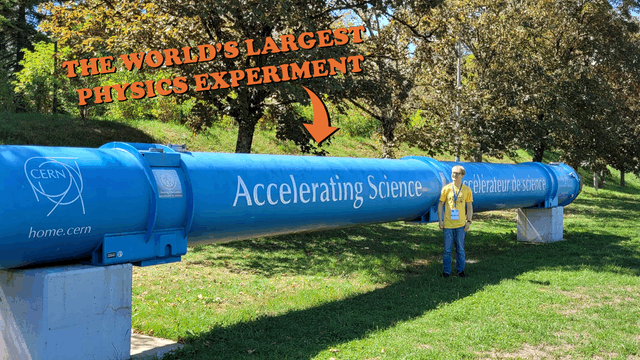
You can view the video here: The World’s Largest Physics Experiment
Below my feet is the largest physics experiment in the world: the Large Hadron Collider. 100 metres underground, a 27-kilometre long tunnel contains the highest-energy particle accelerator ever built.
In 2012, it made history for discovering the Higgs boson, collecting enormous amounts of data to prove a then (almost) 50-year-old theory. That bit made the headlines, but it’s not what I’m explaining today. For now, I want to explain how the collider works.
Linac4
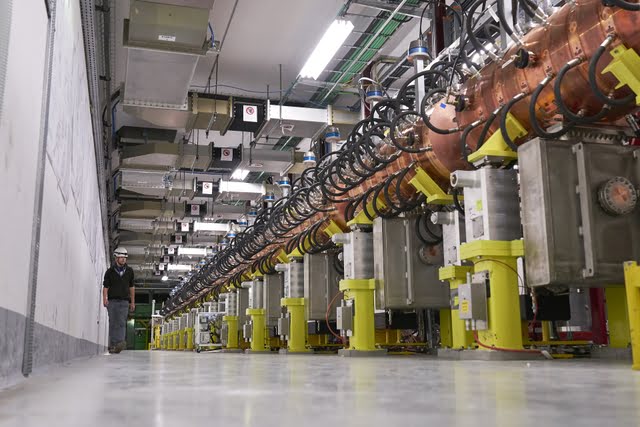
It all starts with Linac4 - a linear accelerator which begins the process of bringing protons up to speed. Instead of the circular shape of other accelerators, Linac4 is a straight tube through which hydrogen ions are pushed before being stripped of their electrons to leave just protons.
There are two main ways of accelerating charged particles like protons, and they both operate on the same principle. It is worth taking a moment before we continue with the protons’ journey to explore how they are accelerated.
How To Accelerate a Proton
Particles enter a chamber with a magnetic or electric field applied. The field is repulsive at the starting end and attractive at the finishing end, which forces particles towards the end of the chamber. This is achieved by using differently charged fields at either end of the chamber, as two similar charges repel whilst opposite charges attract - like a bar magnet.
With particles racing towards the end of the chamber, the charges of the field are flipped, forcing them out of the chamber instead of getting stuck by the field. This process repeats in a series of chambers, pulling the particles up to higher and higher speeds until they reach their final destination.
The Proton Synchrotrons
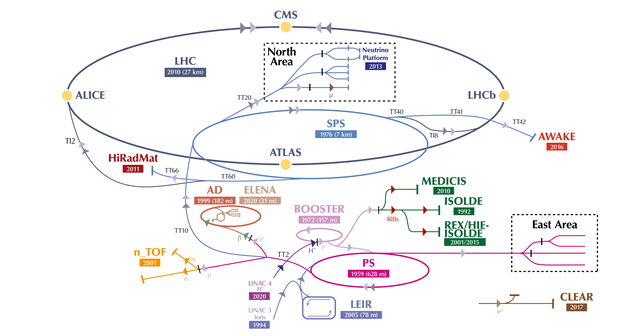
In the case of Linac4, this destination is another accelerator, the Proton Synchrotron Booster, or PSB - where the accelerator field of Linac4 is replaced by a series of magnetic and electric fields in the PSB’s circular accelerator. The main role of this accelerator is to get the protons up to speed for the aptly named Proton Synchrotron, or PS.
The PS then takes over, with protons continuing to be accelerated inside its 628 metre long ring, before they make their way to the final feeder accelerator: the Super Proton Synchrotron, or (to continue the amazing naming scheme) the SPS.
Measuring 6.9 kilometres in length, and accelerating protons up to 99.9998 % the speed of light, the SPS prepares the protons for injection into the LHC. At this point, the protons circling the accelerator ring are in ‘bunches’ with over 11 trillion protons per bunch - that’s an 11 with 12 zeroes after it!
Injection and Collision
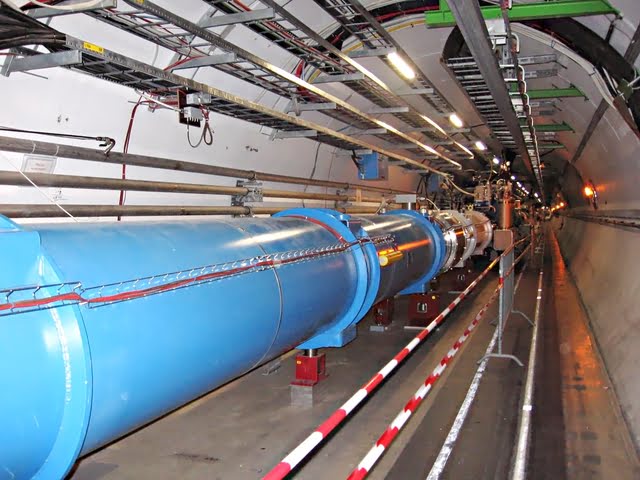
These bunches are injected into the Large Hadron Collider in opposing directions, where they are accelerated up to full speed - now just 0.7134 metres per second (or roughly 2.57 kilometres per hour) slower than the speed of light. Then, this journey of the protons comes to a sudden stop inside one of the four detectors on the LHC ring, as two bunches collide at the end of their just-over 45-minute journey through the CERN accelerator complex.
At 600 million collisions per second, the data collected from the LHC detectors is enormous - with each collision coming in at 1 megabyte (MB) of data, that means that roughly 1 petabyte (PB) is collected every single second, equivalent to 200 thousand DVDs.
And that is pretty cool.
The High Luminosity Upgrade
The next upgrade to the Large Hadron Collider means that some of these figures will be getting larger, but the underlying principles remain the same and the project will continue to collect data until at least 2040.
Sources
- CalculatorCorp Editorial Team (2023). Proton Velocity Calculator | Find Speed for Any Kinetic Energy. [online] Calculator Corp. Available at: calculatorcorp.com/proton-velocity-calculator [Accessed 20 Aug. 2026].
- Cid Vidal, X. and Cid Manzano, R. (2015). LHC Data Analysis. [online] Taking a closer look at LHC. Available at: lhc-closer.es/taking_a_closer_look_at_lhc/0.lhc_data_analysis [Accessed 20 Aug. 2026].
- Cid Vidal, X. and Cid Manzano, R. (2015). LHC p collisions. [online] Taking a closer look at LHC. Available at: lhc-closer.es/taking_a_closer_look_at_lhc/0.lhc_p_collisions [Accessed 20 Aug. 2026].
- Cid Vidal, X. and Cid Manzano, R. (2015). LHC running. [online] Taking a closer look at LHC. Available at: lhc-closer.es/taking_a_closer_look_at_lhc/0.lhc_running [Accessed 20 Aug. 2026].
- Cid Vidal, X. and Cid Manzano, R. (2017). LINAC4. [online] Taking a closer look at LHC. Available at: lhc-closer.es/taking_a_closer_look_at_lhc/0.linac4 [Accessed 20 Aug. 2026].
- European Organization for Nuclear Research (2025). The Large Hadron Collider. [online] CERN. Available at: home.cern/science/accelerators/large-hadron-collider [Accessed 20 Aug. 2026].
- European Organization for Nuclear Research (2025). The Proton Synchrotron Booster. [online] CERN. Available at: home.cern/science/accelerators/proton-synchrotron-booster [Accessed 20 Aug. 2026].
- Favre-Felix, N. (2008). LHC: How fast do these protons go? Journal. Available at: log.kv.io/post/2008/09/12/lhc-how-fast-do-these-protons-go [Accessed 20 Aug. 2026].
- Wikipedia Contributors (2002). Particle accelerator. In: Wikipedia. [online] Wikimedia Foundation. Available at: en.wikipedia.org/wiki/Particle_accelerator [Accessed 20 Aug. 2026].
- Wikipedia Contributors (2003). Higgs boson. In: Wikipedia. [online] Wikimedia Foundation. Available at: en.wikipedia.org/wiki/Higgs_boson [Accessed 20 Aug. 2026].
- Wikipedia Contributors (2003). Large Hadron Collider. In: Wikipedia. [online] Wikimedia Foundation. Available at: en.wikipedia.org/wiki/Large_Hadron_Collider [Accessed 20 Aug. 2026].
- Wikipedia Contributors (2007). Proton Synchrotron Booster. In: Wikipedia. [online] Wikimedia Foundation. Available at: en.wikipedia.org/wiki/Proton_Synchrotron_Booster [Accessed 20 Aug. 2026].
Read more about how I use Wikipedia.
Image Credit:
- Thumbnail image by Reuben Skinner
- “The Linac4 facility at CERN” by Maximilien Brice, CC BY-SA 4.0, via Wikimedia Commons
- “A graphic overview of all accelerators in operation at CERN.” by Landua, Fabienne, CC BY 4.0, via Wikimedia Commons
- “CERN LHC Tunnel1” by Julian Herzog (Website), CC BY-SA 3.0, via Wikimedia Commons